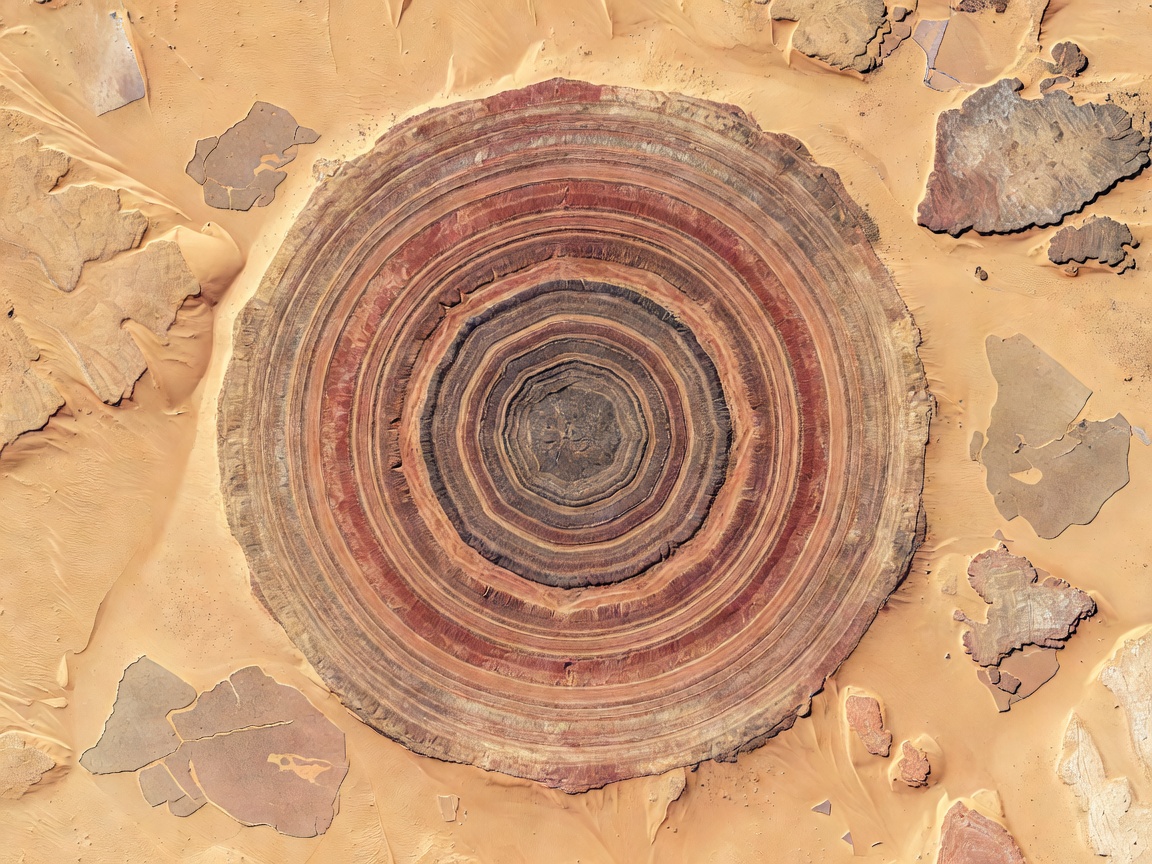
High above the Mauritanian desert in West Africa sits a symmetrical 40-kilometer-wide bullseye pattern known formally as the Richat Structure. Early astronaut crews on Gemini missions used it as a landmark because of its striking blue-grey concentric circles visible against the endless red sand dunes.
The Impact Theory vs. Magmatic Dome
For decades, planetary geologists suspected the Richat Structure was created by a massive meteorite impact due to its near-perfect circular symmetry. However, extensive field sampling across the central core revealed no shock-metamorphosed quartz, shatter cones, or extraterrestrial mineral residues.
The Erodible Geological Dome Explanation
The prevailing scientific consensus today posits that the Richat Structure is a deeply eroded alkaline magmatic dome created 100 million years ago during the breakup of Pangaea. Deep mantle plumes pushed molten magma up into layers of Proterozoic sandstone, creating a massive bulge. Over tens of millions of years, water, wind, and hydrothermal dissolution eroded the softer layers of rock faster than the hard quartzite, creating concentric rings of ridges and valleys.
Hydrothermal Breccia Core
At the very center of the "Eye" lies a massive deposit of hydrothermal breccia—shattered rock cemented together by mineral-rich hot springs that erupted when the magma dome reached peak pressure. This unique chemistry makes the location a prime research site for early geological fluid dynamics.