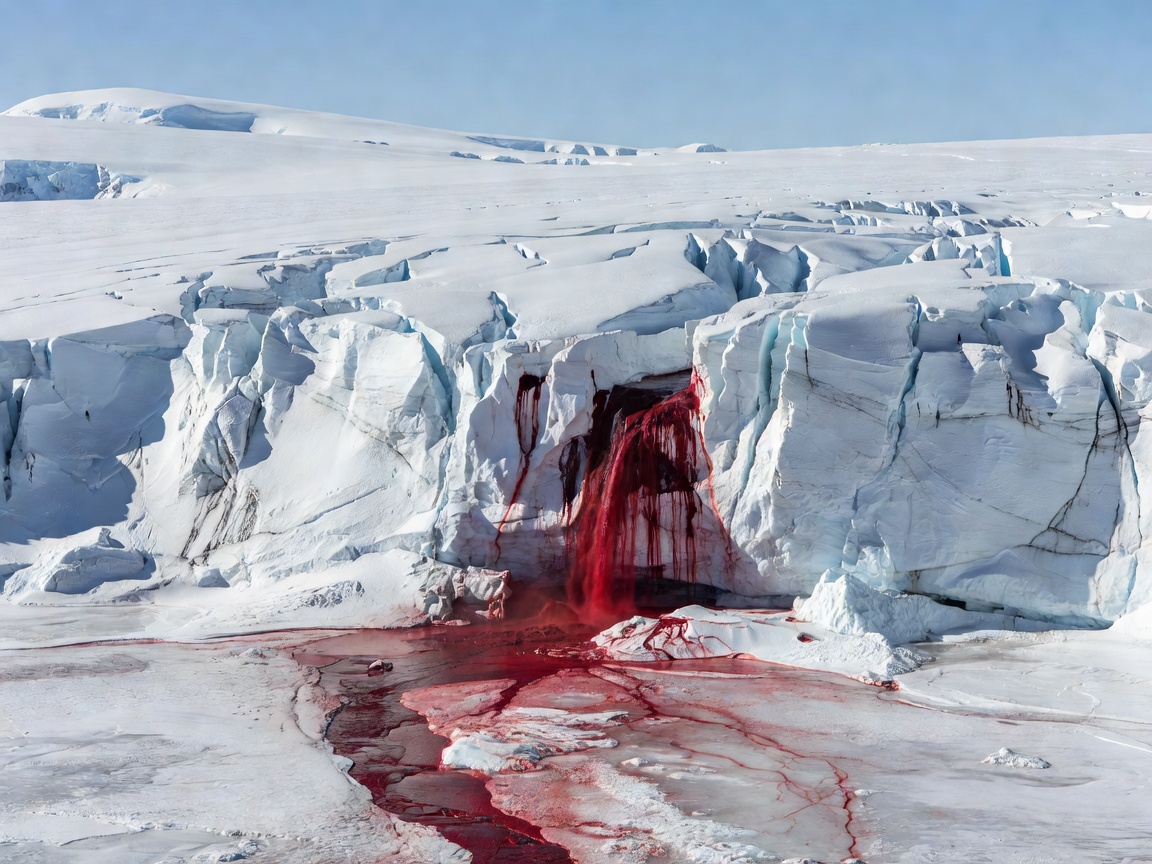
First discovered in 1911 by Australian geologist Griffith Taylor, early explorers assumed the striking blood-red stain bleeding from the glacier was caused by red algae. Modern microbial research revealed a far more uncanny reality.
The Subterranean Sealed Reservoir
Approximately 2 million years ago, a fjord was capped by a glacier, sealing a body of saltwater beneath hundreds of meters of ice. Trapped without light, oxygen, or heat, this ancient lake turned into a hypersaline pressure cooker enriched with iron ions originating from subglacial bedrock erosion.
Why It Bleeds Red
The subglacial liquid is three times saltier than seawater, keeping it liquid even at sub-zero temperatures (-7°C). When force squeezes this liquid through fissures in the glacier ice to the outside air, the dissolved ferrous iron immediately oxidizes upon contact with oxygen, instantly rusting and turning deep crimson.
Implications for Alien Life (Astrobiology)
Microbiologists identified an isolated community of autotrophic bacteria surviving deep inside the oxygen-free brine by metabolizing iron and sulfate compounds. This microbial ecosystem serves as a prime terrestrial model for life on Europa (Jupiter's moon) and Enceladus (Saturn's moon).