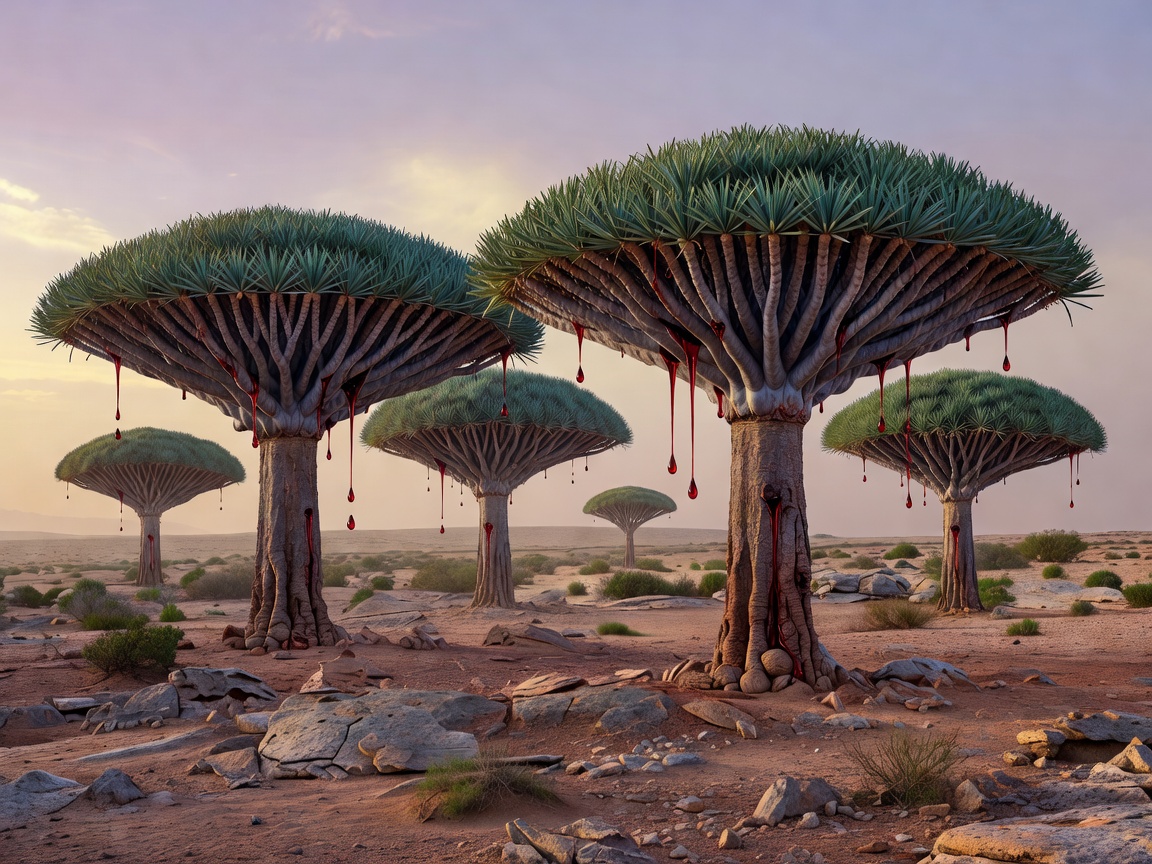
Located in the Arabian Sea between the Horn of Africa and the Arabian Peninsula, Socotra resembles sci-fi imagination brought to life. Because of its extreme isolation, 37% of Socotra's 825 plant species exist nowhere else on planet Earth.
The Dragon's Blood Tree (Dracaena cinnabari)
The most iconic feature of Socotra is the Dragon's Blood Tree. Resembling an upturned umbrella, its unique crown structure allows the tree to capture moisture from ocean mists and funnel condensed water drops directly down to its shallow roots beneath the scorching sun.
When the trunk is cut, it bleeds a thick, crimson-red resin that has been harvested since antiquity for medicinal remedies, dye, and alchemy.
A Living Laboratory of Speciation
Geologists estimate that Socotra separated from the African mainland around 18 million years ago. This long isolation produced extraordinary adaptations:
- Cucumber Tree (Dendrosicyos socotrana): The only tree species belonging to the gourd family, featuring a swollen trunk designed to store water.
- Desert Rose (Adenium obesum socotranum): Massive bulbous trunks with delicate pink flowers blooming directly from grey bark.
- Endemic Reptiles: Over 90% of Socotra's reptile species are entirely unique to the island.
UNESCO Conservation Report
Explore UNESCO's full biodiversity index for Socotra: UNESCO World Heritage Centre.