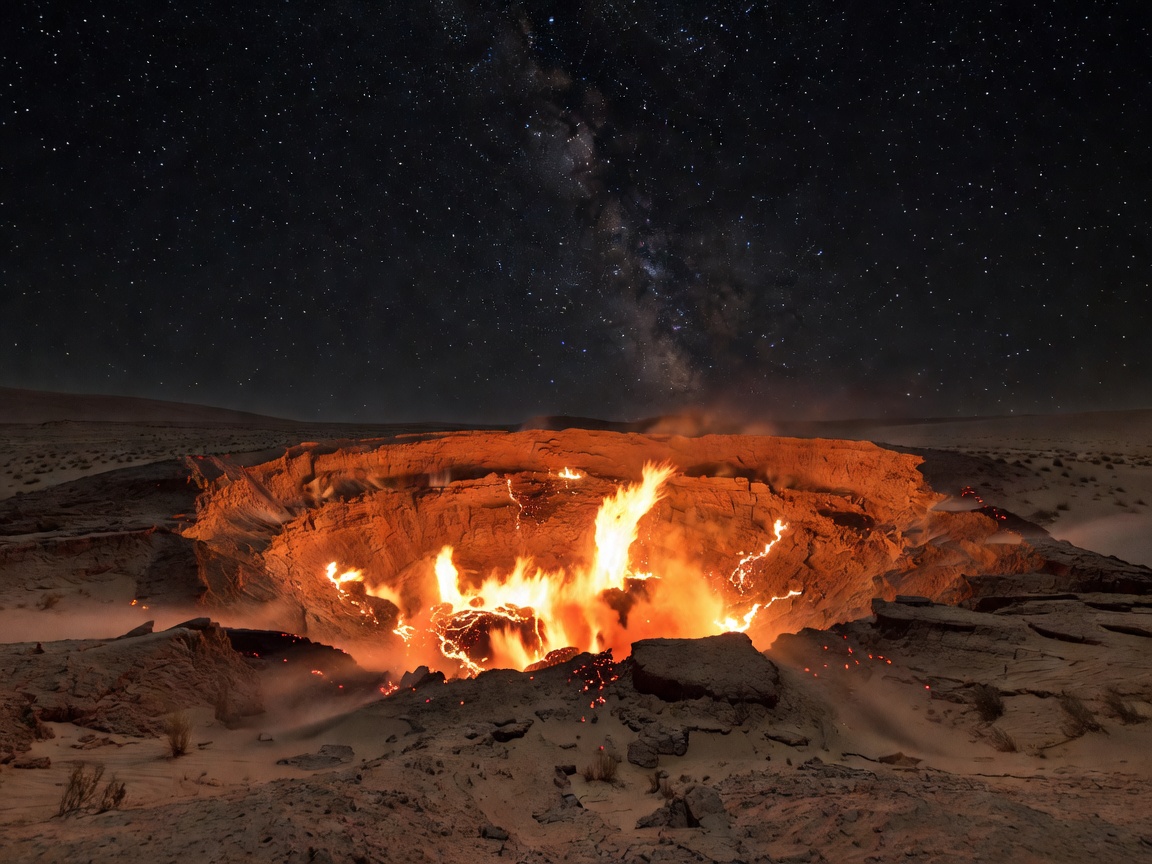
Deep within the sun-bleached expanse of the Karakum Desert in Turkmenistan lies a fiery chasm 70 meters wide and 30 meters deep. Known locally as the "Door to Hell," the Darvaza Gas Crater is a mesmerizing testament to human error and raw subterranean chemical energy.
Origins of the Inferno
In 1971, Soviet engineers setup a drilling rig on the site expecting a major oil field. Shortly after drilling commenced, the ground beneath the rig collapsed into a giant underground pocket of natural gas, swallowing the equipment. Fearing the release of toxic hydrogen sulfide and methane into nearby villages, scientists decided to ignite the escaping gas, anticipating it would burn off in a few weeks.
Fifty-five years later, the crater continues to vent pressurized methane, maintaining a roaring cauldron of fire that illuminates the desert sky for miles around.
Extremophile Discoveries
In November 2013, explorer George Kourounis became the first person to descend to the bottom of the crater. Wearing a heat-reflective suit and breathing apparatus, he collected soil samples from the bottom of the fiery pit. Astrobiologists subsequently discovered unique species of extremophile bacteria living in the high-temperature, methane-rich soil—bacteria capable of thriving in conditions resembling extraterrestrial planets.
Key Scientific Observations
- Continuous Venting: Methane plumes migrate upward from deep Jurassic hydrocarbon reservoirs.
- Biological Significance: Serves as an analog for potential life forms in extreme heat environments on Mars or Venus.
- Thermal Gradient: Rim temperature averages 40°C while floor sensors read upwards of 1,000°C.
Official Geological Reference
For scientific data on natural gas reserves in the Karakum basin, visit the official energy portal: Nature Geoscience Archives.